
Wireless & Cellularintermediateselection guide
SIM800C to A7670C: Planning a 2G to 4G Migration
When to move an Indian IoT product from 2G to LTE Cat 1: network status, firmware and hardware impact, power budget, BOM cost and a decision framework.
By ADIY13 min read
Technical review pending. Figures marked “verify” or “check your part” have not been confirmed against your exact hardware revision. Check the manufacturer datasheet before relying on them in a design.
Every few months someone tells the Indian IoT industry that 2G is about to disappear and everyone must migrate immediately. That is not what the evidence says. Here is the actual position, and a framework for deciding whether your product needs to move now, later, or not at all.
1. The actual status of 2G in India#
Let us be precise about this, because a lot of migration advice in circulation overstates the urgency in order to sell modules.
The reason 2G persists is not technical inertia, it is arithmetic. India retains a very large feature phone user base, commonly estimated in the range of 250 to 300 million subscribers. Switching off 2G strands those users. No operator wants to be the first to do that at scale, and the regulatory environment has not forced the issue. Estimates of subscriber counts vary by source and should be treated as approximate.
So if you have a deployed fleet of SIM800-based devices, you are not facing an imminent cliff. What you are facing is a slow narrowing of options, and the fact that new designs specified on 2G today are being born with a shorter service life than the product will plausibly need.
2. Why migrate at all, then#
There are four defensible reasons, and they have nothing to do with panic.
Product service life#
If you are designing an energy meter, an industrial controller or a water infrastructure device with a ten to fifteen year expected service life, specifying 2G in 2026 means betting that 2G will still be there in 2040. That is not a good bet even without a fixed shutdown date. For consumer products with a three year life the calculus is different.
Capability ceiling#
GPRS and EDGE data rates cap out at roughly 236.8 kbps in supplier specifications, and real-world throughput is a fraction of that. LTE Cat 1 gives you roughly 10 Mbps down and 5 Mbps up. That is the difference between telemetry only and a product that can take a firmware update over the air, upload a diagnostic log, or send an image. Over-the-air update capability alone has changed the economics of field service for a lot of our customers.
Latency and session reliability#
2G attach times and session setup latency are meaningfully worse than LTE. For anything with a control path, not just a reporting path, this shows up as user-visible sluggishness.
Supply chain direction#
Module vendors are steering new development towards LTE Cat 1 and Cat 1 bis. Over a long enough horizon, 2G module availability, firmware support and pricing all move in the wrong direction. This is a real risk for a product you intend to build for years.
3. SIM800C and A7670C side by side#
| Parameter | SIM800C | A7670C |
|---|---|---|
| Technology | GSM / GPRS, 2G | LTE Cat 1, with GSM fallback |
| Downlink | GPRS / EDGE class, up to approx. 236.8 kbps | Up to approx. 10 Mbps |
| Uplink | Up to approx. 236.8 kbps | Up to approx. 5 Mbps |
| LTE bands | Not applicable | FDD B1, B3, B5, B8; TDD B34, B38, B39, B40, B41 |
| GSM bands | Quad band | 900 / 1800 MHz |
| Supply voltage | Approx. 3.4 to 4.4 V (check your variant) | 3.4 to 4.2 V |
| Peak TX current | Approx. 2 A class | Greater than 2 A |
| Operating temperature | Check variant datasheet | -40 °C to +85 °C |
| Expected network longevity in India | Narrowing | Long |
4. Hardware impact#
This is not a component swap. Plan for a board revision.
Power delivery is the big one#
Both modules have high peak current, but the LTE transmit burst profile is more demanding and the supply rail must hold up through it. If your existing SIM800C design has a regulator sized with thin margin, and many do because it worked, that regulator will not carry an LTE design. Expect to revisit:
- Regulator selection, specifically peak current capability and transient response, not just the average rating on the front page of the datasheet
- Bulk capacitance at the module supply pins, typically 470 uF to 1000 uF low-ESR plus ceramic decoupling
- Copper pour and trace width on the supply path, since IR drop at 2 A over a thin trace is not negligible
- Battery internal resistance if you are running from a cell, because a battery that sags under a 2 A pulse will brown out the module regardless of your regulator
RF and antenna#
You are now covering a much wider frequency range, including TDD bands well above the GSM bands your old antenna was tuned for. A 2G antenna will not perform correctly across LTE B40 and B41. Budget for antenna reselection and, ideally, for measuring performance in the final enclosure rather than on the bench. Enclosure material and nearby metalwork detune antennas significantly, and this is where field failures originate.
Footprint and mechanical#
The packages differ. If you are working at module level rather than with a breakout, this is a full PCB layout change including the RF trace to the antenna connector, which needs controlled impedance.
5. Firmware impact#
The basic 3GPP TS 27.007 commands carry over almost unchanged, which lulls teams into underestimating the port. The divergence is in the value-added stacks, and that is where most of your firmware lives.
| Area | Effort | Notes |
|---|---|---|
Basic AT, AT+CPIN?, AT+CSQ, AT+COPS | Low | Standardised by 3GPP. Largely portable. |
| Registration polling | Low to medium | Move from AT+CREG / AT+CGREG to AT+CEREG for the LTE domain. |
| PDP context and bearer setup | Medium | SIM800 SAPBR flow is replaced by CGDCONT and CGACT. |
| HTTP stack | Medium | Command names are similar but parameters and response formats differ. Re-test every path. |
| MQTT stack | High | SIM800 has no comparable native MQTT. The CMQTT command set is new work. |
| TLS and certificates | High | Different certificate management commands and storage. Budget real time for this. |
| Error and reconnection handling | High | Failure modes differ. Your existing retry state machine will have wrong assumptions baked in. |
6. Power budget#
The instinct is that 4G costs more power than 2G. That is true for peak current and it is not automatically true for energy per message.
Consider a device sending a 200 byte telemetry payload every fifteen minutes. On 2G, the attach and transfer occupies the radio for a comparatively long window at moderate current. On LTE Cat 1 the peak is higher but the transfer completes faster, so the area under the curve may be similar or better. Whether you come out ahead depends on:
- How often you transmit
- Whether you stay attached between transmissions or detach and re-attach
- Whether you use power saving mode or extended discontinuous reception, if your operator supports them
- Signal quality, since a marginal link means retransmissions and retransmissions dominate the energy budget
7. Cost and certification#
Module cost is the visible delta, and LTE Cat 1 modules carry a premium over 2G. But module price is usually the smaller part of the total. Account for:
- Module BOM delta. Real, but check current pricing rather than assuming, because the gap has narrowed considerably as Cat 1 volumes have grown.
- Supporting BOM. A larger regulator, more bulk capacitance and a broadband antenna each add cost.
- Engineering time. Board revision plus firmware port plus test. On any realistic project this exceeds the BOM delta by a wide margin.
- Certification. Any change to the radio front end has regulatory implications. In India, wireless equipment is subject to WPC and related approvals, and requirements depend on your product category and whether you are using a pre-certified module. Confirm the current requirements with a test house rather than relying on secondary sources, including this one, since these rules change.
- Data tariffs. Often lower per megabyte on 4G, but check your M2M plan rather than assuming.
8. A decision framework#
| Your situation | Recommendation |
|---|---|
| New design, service life over 5 years | Specify LTE Cat 1 now. There is no good argument for starting a long-life product on 2G in 2026. |
| New design, short life, extreme cost sensitivity, low data | 2G remains defensible. Document the decision and the assumed network lifetime so it is a conscious trade, not an accident. |
| Deployed fleet, working, no new feature demand | No emergency. Monitor operator announcements. Begin design work on the successor so you are not rushed later. |
| Deployed fleet, customers asking for OTA update or richer data | Migrate. The capability gap, not the network, is your driver. |
| Deployed fleet on a Vi-heavy SIM estate | Bring the timeline forward and talk to your SIM provider about their migration path. |
| Product sold into export markets | Check destination market status separately. Several markets are considerably further along in 2G shutdown than India. |
A sensible sequence#
- Get an A7670C breakout onto the bench and port your existing firmware to it as a spike, before committing to a board revision. Two weeks here will tell you what the real porting effort is.
- Measure energy per message on both modules under realistic signal conditions.
- Confirm band support against your deployment geography and operator.
- Revise the power path first. It is the most common cause of late-stage failure.
- Reselect the antenna and validate it in the final enclosure, not on the bench.
- Plan certification early, since lead times are usually longer than engineers expect.
FAQ#
Has 2G been switched off in India?
No. As of mid 2026 there is no complete 2G shutdown in India. Airtel and Jio continue to operate 2G networks. Vodafone Idea has signalled plans for a partial shutdown across 2026 and 2027. A very large feature phone user base makes a rapid nationwide shutdown commercially difficult, so 2G coverage is expected to persist for some time. This is a planning consideration rather than an emergency.
Is the A7670C a drop-in replacement for the SIM800C?
No. The footprints differ, the power budget differs substantially because LTE transmit bursts exceed 2 A peak, and the AT command set differs in the areas that matter, particularly the IP, HTTP and MQTT stacks. Plan for a board revision and a firmware port, not a component substitution.
Will migrating to LTE Cat 1 increase my power consumption?
Peak current increases, which affects supply and capacitor selection. Average consumption over a duty cycle depends heavily on how often you transmit and how long the module stays attached. For infrequent telemetry the higher data rate can mean shorter radio-on time, which partly offsets the higher peak. Measure your own duty cycle rather than assuming either direction.
What about NB-IoT or LTE-M instead of Cat 1?
NB-IoT and LTE-M offer better power figures for very low data rate applications, but network availability and operator support in India are more variable than for Cat 1. Cat 1 runs on standard LTE infrastructure that is already deployed nationally. For most Indian deployments today, Cat 1 is the lower risk choice, but confirm coverage with your operator for your specific deployment geography.
Sources#
Sources and further reading#
- Industry 2G and 3G sunset trackers and operator reporting, used for the India network status summary. Operator plans change, so verify against current operator announcements before making a commercial decision.
- Supplier specification summaries for the SIMCom A7670C, used for band list, data rates, supply range, peak current and temperature range.
- SIMCom, A7670 Series Hardware Design and A76XX Series AT Command Manual.
- 3GPP TS 27.007 for the standardised AT command subset discussed in the firmware section.
Products & resources
- ADIY SIM800C LM39302 TTL Board Datasheet
- ADIY SIM7670C 4G Breakout Board V1.1 Datasheet
- ADIY GSM A7670C 4G LTE LM39302 TTL Board V1.1 datasheet
- ADIY SIMA7670E GSM 4G Breakout Board Datasheet
GSM Modules
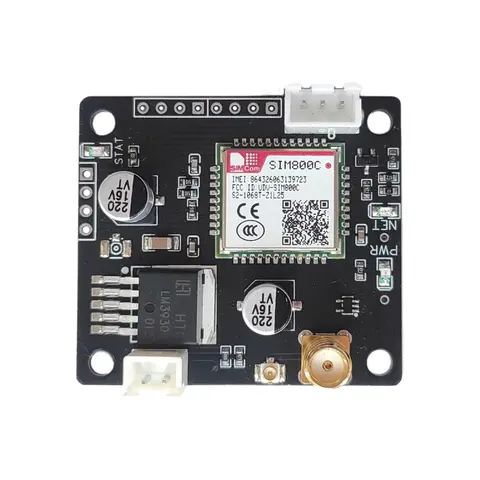
SIM800C LM39302 TTL Board
SIM800C is a Quad-Band GSM/GPRS module in an LCC type that supports GPRS up to 85.6kbps data transfer. It has strong extension capability with abundant interfaces including UART, USB2.0, GPIO, etc. The module provides…
₹1,002
Datasheet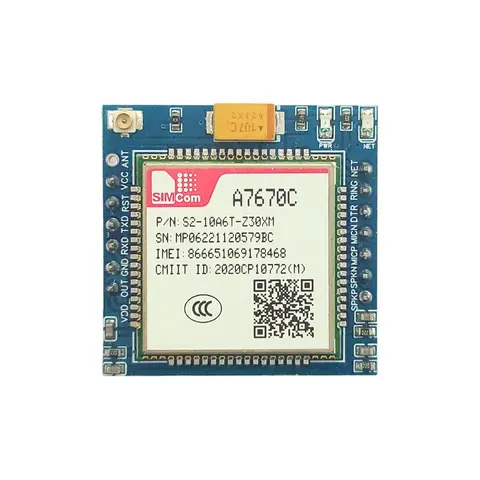
GSM Modules
ADIY GSM SIMA7670C 4G BREAKOUT BOARD (Ver 1.1)
A7670C 4G Development Board A7670C 4G Development Board is a high-performance Cat-1 module that supports LTE-TDD/LTE-FDD wireless communication modes. With a maximum downlink rate of 10Mbps and an uplink rate of 5Mbps,…
₹1,200
Datasheet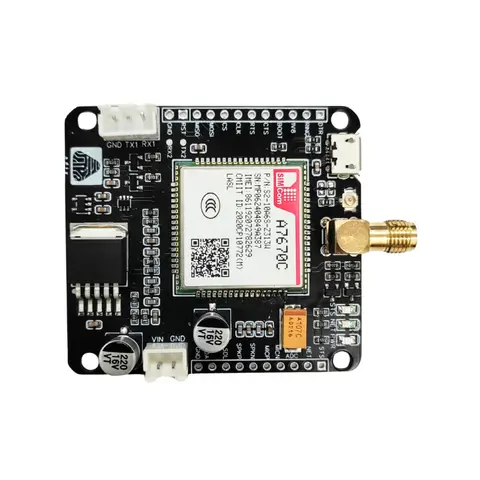
GSM Modules
SIMA7670C 4G/LTE GSM Board (LM39302) V1.1
The ADIY SIM A7670xx 4G LTE Board is a Cat-1 Module which supports wireless communication modes of LTE-TDD/LTE-FDD. It supports maximum 10Mbps downlink rate and 5Mbps uplink rate. This board features a serial interface…
₹1,447
Datasheet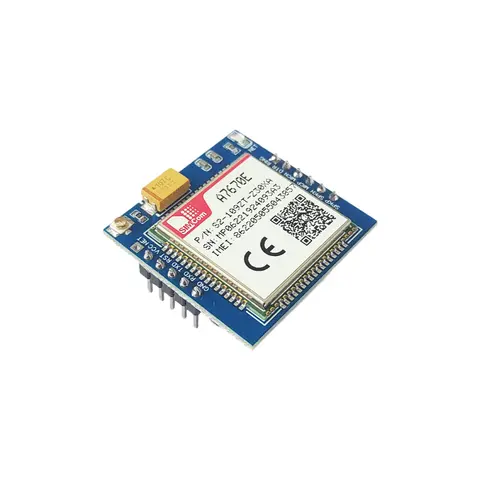
GSM Modules
ADIY GSM SIMA7670E 4G/2G Breakout Board
SIMA7670E 2G/4G Breakout Board module supports wireless communication modes of LTE-FDD/GSM/GPRS/EDGE GSM/GPRS. It supports a maximum 10Mbps downlink rate and a 5Mbps uplink rate. The ADIY SIM_A7670E is compatible with…
₹1,438
Datasheet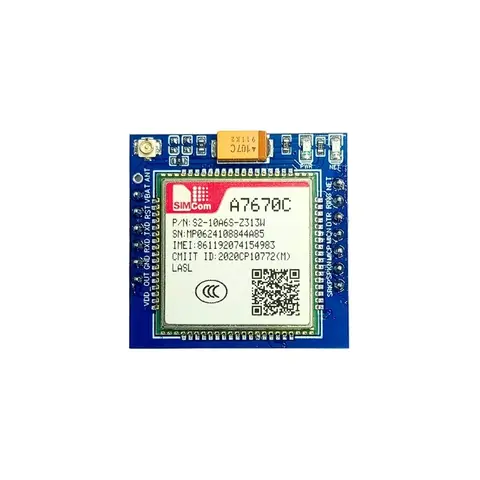
GSM Modules
ADIY GSM SIMA7670C 4G Breakout Board with logic level V1.2
The SIM A7670C 4G LTE breakout Board is a Cat 1 module that supports wireless communication modes of LTE-TDD/LTE-FDD/GSM/GPRS/EDGE. It supports a maximum 10Mbps downlink rate and a 5Mbps uplink rate It supports a…
₹1,425
Share