Wireless & Cellularintermediateselection guide
ESP32-WROOM 32D, 32E, 32U and 32UE: Which Variant
What the D, E, U and UE suffixes mean on ESP32-WROOM modules: antenna type, ECO V3 silicon, NRND status and how to choose for a metal enclosure.
By ADIY10 min read
Technical review pending. Figures marked “verify” or “check your part” have not been confirmed against your exact hardware revision. Check the manufacturer datasheet before relying on them in a design.
One letter in the part number decides whether your product works inside a metal enclosure. Another decides whether the part will still be recommended in three years. Neither is obvious from the listing, and getting it wrong is not fixable in firmware.
1. Decoding the suffixes#
Two independent things are encoded in the part number, which is why four combinations exist.
| Part | Antenna | Generation | Lifecycle |
|---|---|---|---|
| ESP32-WROOM-32D | PCB antenna | Earlier | NRND (verify before relying on this) |
| ESP32-WROOM-32U | External, U.FL type connector | Earlier | NRND (verify before relying on this) |
| ESP32-WROOM-32E | PCB antenna | ECO V3 generation | Current (source stated) |
| ESP32-WROOM-32UE | External, IPEX / U.FL type connector | ECO V3 generation | Current (source stated) |
2. The antenna decision, which is the one that bites#
This is the choice that most often gets made by accident and discovered in the field.
PCB antenna (D and E variants)#
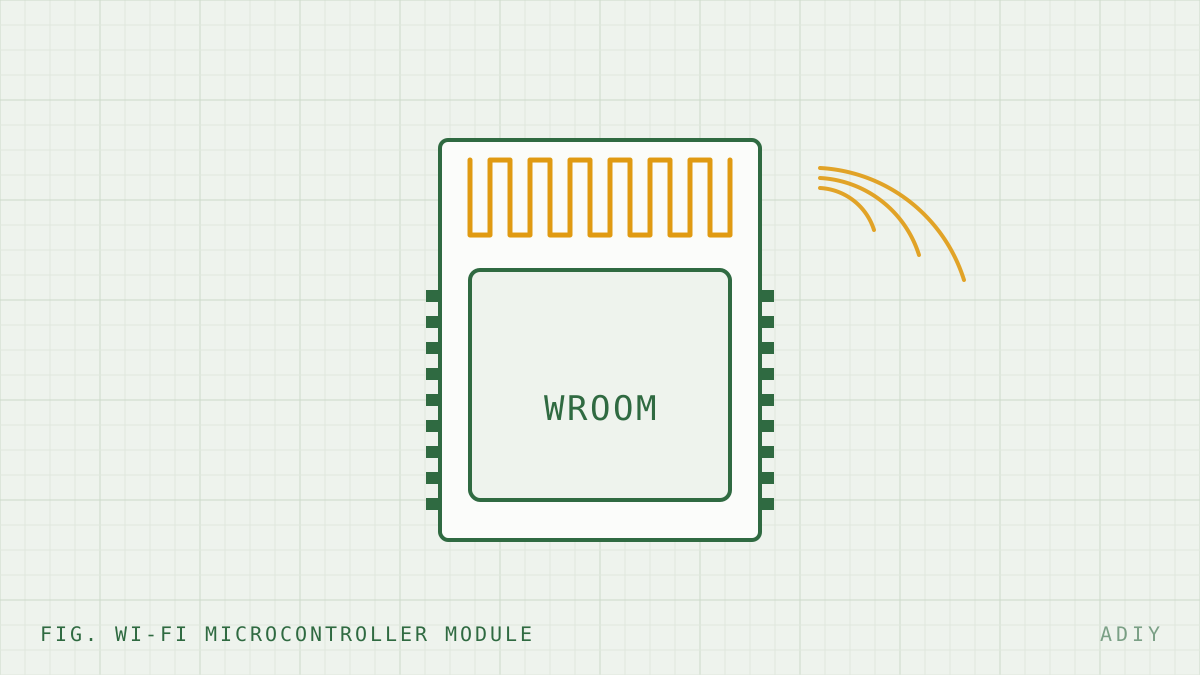
The antenna is etched into the module's own circuit board, visible as the zigzag copper trace at one end. It costs nothing extra, needs no assembly, cannot be forgotten during manufacture, and performs well in free space.
It has one requirement: the space around it must be transparent to radio. Specifically it needs keep-out. No copper pour underneath, no ground plane adjacent, no metal near it, and the module positioned at the edge of the carrier board rather than in the middle.
External antenna (U and UE variants)#
Instead of the etched trace there is a small coaxial connector, of the U.FL or IPEX type. You fit a pigtail and mount the antenna wherever it will actually work.
| Enclosure or mounting | Choose | Why |
|---|---|---|
| Plastic or ABS box | PCB antenna (E) | Plastic is radio transparent. Keep the antenna end away from internal metalwork. |
| Metal enclosure | External (UE) | Metal blocks the signal. Antenna must be outside. |
| DIN rail industrial panel | External (UE) | Panels are metal and usually full of other equipment. |
| Wall mounted behind a metal plate | External (UE) | Same problem as an enclosure. |
| Inside machinery | External (UE) | Antenna needs to reach outside the machine. |
| Open board, development, education | PCB antenna (E) | Simplest, cheapest, nothing to fit or break. |
| Long range or weak access point signal | External (UE) | Lets you fit a higher gain antenna, or reposition it. |
| Potted or sealed assembly | Depends on potting material | Test it. Some compounds detune a PCB antenna significantly. |
3. What ECO V3 changed#
The 32E and 32UE are built on the ESP32 ECO V3 chip revision. Espressif documentation identifies this generation as bringing bug fixes and security improvements over the earlier revision used in the 32D and 32U, including in the boot and flash encryption area.
4. The ADIY range#
ADIY stocks five ESP32 boards, and they split into two groups.
Nodemcu style boards#
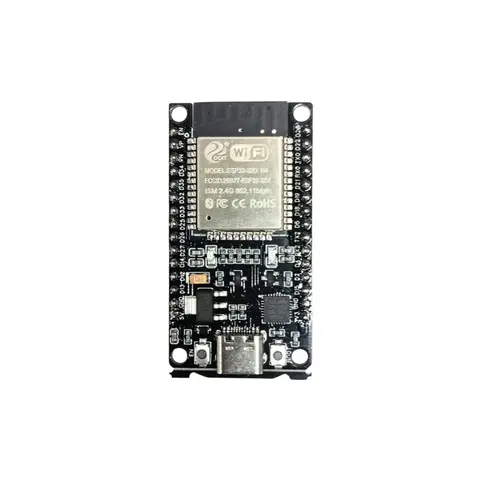
Four boards in the familiar breadboard-friendly nodemcu form factor, differing in which WROOM module is fitted: the 32D, 32E, 32U and the newer ESP32UE. All use a CP2102 family USB to serial bridge, so the driver situation is the same across them; see our USB serial troubleshooting guide if a board does not enumerate.
UNO form factor board#
The ESP32 Development Board Compatible with UNO puts an ESP32 on a board with the Arduino UNO shield footprint. This is a genuinely useful part in one specific situation: you have an existing UNO-based design using shields, and you want Wi-Fi and considerably more processing power without redesigning the mechanical arrangement.
5. Decision summary#
| Situation | Choose |
|---|---|
| Learning, prototyping, plastic enclosure | 32E nodemcu. Current silicon, no antenna to fit. |
| New product, metal enclosure or industrial panel | 32UE. External antenna is not optional here. |
| New product, long service life, plastic enclosure | 32E. Avoid starting on NRND parts. |
| Adding Wi-Fi to an existing UNO shield stack | ESP32 UNO-compatible board, after checking logic levels and library support. |
| Range is marginal at the install location | 32UE with a higher gain external antenna. |
| Secure boot or flash encryption required | 32E or 32UE, verified against the Espressif datasheet for your revision. |
| Replacing a failed unit in an existing deployment | Match what is already there unless you are prepared to retest. |
| Cost is the only consideration, short-life product | 32D. NRND matters little for a product with a two year life. |
FAQ#
What does the U mean in ESP32-WROOM-32U?
An external antenna connector instead of the on-board PCB antenna. Espressif documentation states the 32D has a PCB antenna while the 32U has a connector compatible with U.FL series connectors from Hirose. The same convention applies to the 32E and 32UE pair.
What is the difference between ESP32-WROOM-32E and 32UE?
The antenna. The 32E has a PCB antenna, the 32UE a connector for an external one. Both use the same newer generation silicon, identified in Espressif documentation as the ESP32 ECO V3 revision, which brought bug fixes and security improvements over the revision in the 32D and 32U.
Should I still use ESP32-WROOM-32D for a new design?
Espressif marks the 32D and 32U as Not Recommended For New Designs. They work and remain available, so existing designs and prototyping are unaffected. For a new product intended to be built for several years, specify the 32E or 32UE on supply continuity grounds.
Do I need an external antenna for my ESP32 project?
Only if the enclosure will block the PCB antenna. Plastic enclosures are usually fine. Metal enclosures, metal panels and mounting against a large ground plane will degrade or block it, and in those cases you need a U variant with the antenna outside the metalwork.
Can I add an external antenna to a PCB antenna module?
Not reliably. The PCB antenna is part of the module's RF design and certification, there is no connector to attach to, and modifying the module invalidates certification and will degrade performance. Choose the correct variant at design time.
Sources#
Sources and further reading#
- Espressif Systems, ESP32-WROOM-32D & ESP32-WROOM-32U Datasheet. Source for the PCB versus U.FL antenna distinction and lifecycle status.
- Espressif Systems, ESP32-WROOM-32E & ESP32-WROOM-32UE Datasheet. Source for the newer generation antenna configuration and chip revision.
- Espressif documentation on the ESP32 ECO V3 chip revision, for the silicon generation differences.
- ADIY product listings for the boards stocked and the USB bridge fitted.
Products & resources
- ADIY ESP32D Datasheet
- ADIY ESP32E Datasheet
- ADIY ESP32U Datasheet
- ADIY ESP32UE Datasheet
- ADIY ESP32 Development Board Compatible^Gwith^GUNO Datasheet
 New
WiFi Modules
ADIY Nodemcu 32D – CP2102 Board
ESP32 Development board is based on the ESP32-WROOM-32 Module, which consists of ESP32 series microcontroller from DOIT. It is a Wi-Fi + Bluetooth + BLE development board. The module has a 32-Bit Dual Core MCU,…
₹526
Datasheet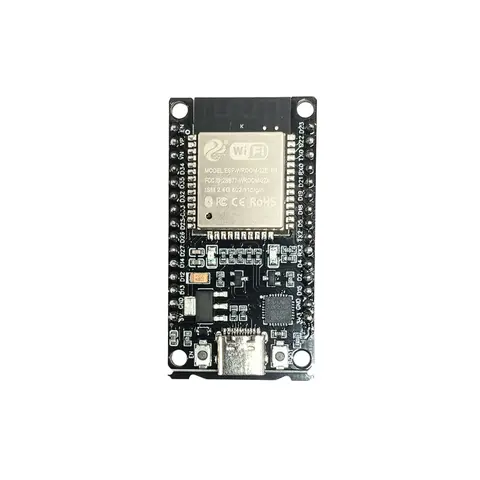 New
WiFi Modules
ADIY Nodemcu 32E – CP2102 Board
ESP32 Development board is based on the ESP32-WROOM-32E Module, which consists of ESP32 series microcontroller from DOIT. It is a Wi-Fi + Bluetooth + BLE development board. The module has a 32-Bit Dual Core MCU,…
₹526
Datasheet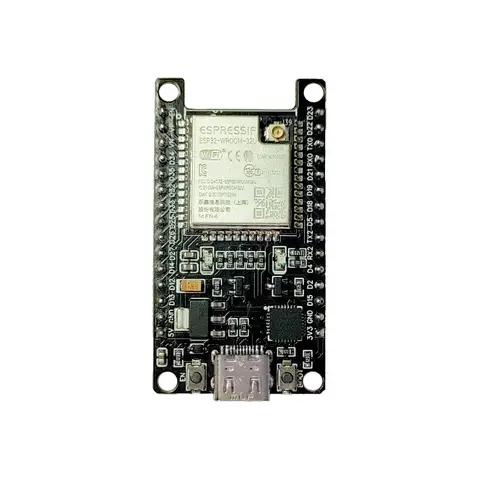 New
WiFi Modules
ADIY Nodemcu 32U – CP2102 Board
The ESP32 Development Board features the ESP32-WROOM-32U Module , powered by the ESP32 series microcontroller from Espressif. This versatile board combines Wi-Fi, Bluetooth, and BLE capabilities, driven by a 32-bit…
₹529
Datasheet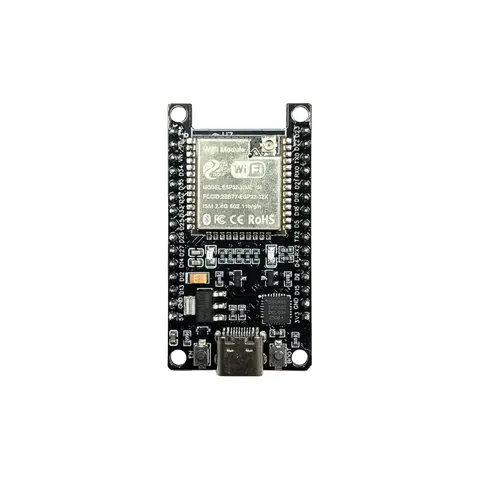
WiFi Modules
ADIY Nodemcu Esp32UE – CP21012 Board
ESP32 Development board is based on the ESP32-WROOM-32UE Module, which consists of ESP32 series microcontroller from DOIT. It is a Wi-Fi + Bluetooth + BLE development board. The module has a 32-Bit Dual Core MCU,…
₹530
Datasheet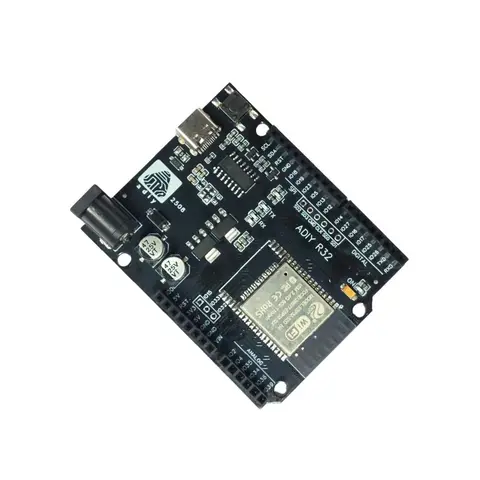
Development Boards and Shields
ADIY ESP32 Development Board Compatible with UNO
The ADIY ESP32 Development Board Compatible with UNO (D1 R32) is a high-performance microcontroller board built around the ESP32-WROVER-32 module , offering advanced wireless connectivity and exceptional processing…
₹561
Datasheet
Share